Blog

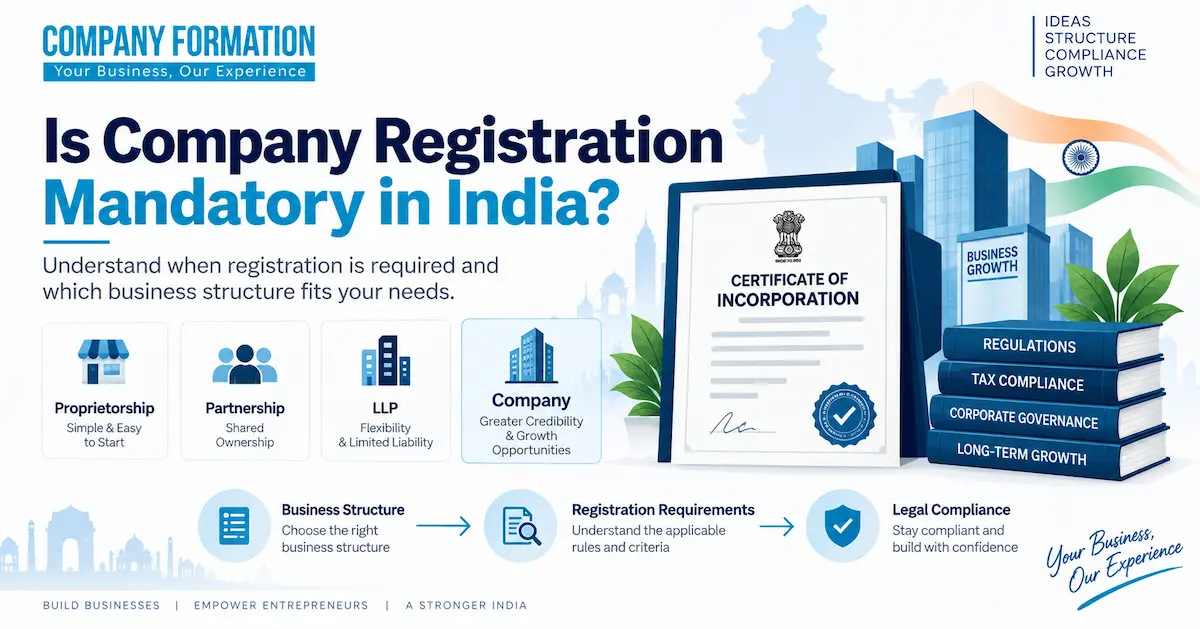
Is Company Registration Mandatory in India?
Starting a business in India raises an important question for many entrepreneurs: Is company registration in India?
The short answer is not for every type of business.
Indian law provides several business structures, including sole proprietorships, partnerships, Limited Liability Partnerships (LLPs), One Person Companies (OPCs), and Private Limited Companies. Whether you need to incorporate a company depends on the legal structure you choose, the nature of your business, and your long-term requirements.
If you specifically want to operate as a Private Limited Company, Public Company, or One Person Company, registration under the applicable company law is required to create that corporate entity. The Companies Act, 2013 provides for the formation and registration of these companies.
Let's understand when company registration is required and what alternatives are available.
What Does Company Registration Mean?
Company registration is the legal process through which a business is incorporated as a company with the Ministry of Corporate Affairs (MCA).
Once incorporated, the company becomes a separate legal entity from its members, subject to the applicable legal structure.
The Companies Act, 2013 provides for the formation of:
- Private Companies
- Public Companies
- One Person Companies
- Companies limited by shares
- Companies limited by guarantee
- Unlimited companies
The Act specifies that a private company can be formed by two or more persons, a public company by seven or more persons, and an OPC by one person, subject to the applicable requirements.
Is Company Registration Mandatory for Every Business?
No.
You do not necessarily have to incorporate a Private Limited Company simply because you want to start a business in India.
For example, an individual may operate through a sole proprietorship, subject to obtaining registrations and licences applicable to the particular business.
Similarly, two or more people may choose a partnership or LLP structure depending on their requirements.
However, if you want to establish a Private Limited Company, you must complete the applicable incorporation process.
Therefore, the better question is:
"Which business structure is appropriate for my business?"
When Is Company Registration Mandatory?
Company incorporation is necessary when you choose a company structure that requires registration under the Companies Act.
1. Private Limited Company
If you want your business to operate as a Private Limited Company, incorporation is mandatory.
A Private Limited Company provides a separate corporate structure and is commonly used by startups, growing businesses, and companies seeking external investment.
2. One Person Company
An OPC is a form of private company that can be formed by one person, subject to the requirements of the Companies Act.
If you want to establish an OPC, the entity must be incorporated according to the applicable company law.
3. Public Limited Company
A public company is also incorporated under the Companies Act and must comply with the applicable requirements for registration and ongoing corporate compliance.
When Is Company Registration Not Necessary?
There are business structures where incorporation as a company is not required.
Sole Proprietorship
A sole proprietorship is operated by an individual and does not have a separate corporate identity from its proprietor.
There is no separate "Private Limited Company" incorporation for a proprietorship.
However, the proprietor may need registrations, licences, or tax registrations depending on the business activity, turnover, location, employees, and applicable laws.
For example, certain businesses may require:
- GST registration
- Shops and Establishments registration
- Trade licence
- Professional tax registration
- Sector-specific licences
The exact requirements depend on the circumstances.
Partnership Firm
A traditional partnership is governed by the applicable partnership law rather than being incorporated as a company under the Companies Act.
Entrepreneurs choosing this structure should understand the implications relating to liability, registration, taxation, and business continuity.
Limited Liability Partnership
An LLP is not a company, but it is a separate legal entity and body corporate governed by the Limited Liability Partnership Act, 2008.
The MCA describes an LLP as a separate legal entity from its partners, with limited liability and perpetual succession.
An LLP therefore requires its own incorporation process, but it is different from Private Limited Company registration.
Company Registration vs Business Registration
These two terms are often confused.
Company Registration
This specifically refers to incorporating a company as a legal corporate entity.
Examples include:
- Private Limited Company
- Public Limited Company
- One Person Company
Business Registration
This is a broader term that can include different registrations and licences required for operating a business.
Depending on the business, these may include:
- GST registration
- MSME/Udyam registration
- Shops and Establishments registration
- Trade licence
- Import Export Code
- Professional or sector-specific licences
Therefore, not having a Private Limited Company does not necessarily mean that a business has no registration or compliance requirements.
Why Do Entrepreneurs Choose Company Registration?
Although company registration is not mandatory for every business, incorporation can offer several advantages.
Separate Legal Identity
A company has a legal identity separate from its members.
This can help establish a formal structure for contracts, assets, banking, investments, and business operations.
Limited Liability
A company limited by shares generally provides members with liability limited to the amount unpaid on their shares, subject to applicable law and circumstances.
Better Investment Structure
A Private Limited Company provides a shareholding structure that can accommodate investors, subject to applicable legal and regulatory requirements.
Business Continuity
A corporate entity can continue independently of changes in its shareholders or directors, subject to applicable law.
Professional Corporate Structure
A registered company can provide a formal structure for dealing with customers, suppliers, financial institutions, employees, and investors.
Should a Small Business Register as a Private Limited Company?
Not necessarily.
The appropriate structure depends on the business owner's requirements.
A small business may consider a proprietorship if:
- There is only one owner
- The business is relatively small
- External investment is not required
- A simple operating structure is preferred
A Private Limited Company may be considered if:
- Multiple shareholders are expected
- The business plans to raise equity investment
- Limited liability is important
- The business plans to scale
- A separate corporate identity is required
- The founders want a structured ownership model
There is no single business structure that is suitable for every entrepreneur.
Is Company Registration Mandatory for Startups?
There is no general rule that every startup must be incorporated as a Private Limited Company.
However, startups seeking equity investment often consider a Private Limited Company because of its share-based ownership structure.
The appropriate structure depends on the startup's founders, funding plans, business activity, risk profile, compliance requirements, and growth strategy.
What Happens After Company Registration?
Incorporation is only the beginning of operating a company.
After registration, a company may need to address applicable requirements such as:
- PAN and TAN
- Opening a corporate bank account
- Maintaining books of accounts
- Statutory registers and records
- Annual filings
- Income tax compliance
- GST compliance, where applicable
- Other sector-specific registrations and licences
The exact compliance requirements depend on the company's activities and circumstances.
Common Misconceptions About Company Registration
"Every Business Must Be a Private Limited Company"
This is incorrect.
India allows multiple business structures, and incorporation as a Private Limited Company is not mandatory for every business.
"No Company Registration Means No Compliance"
This is also incorrect.
A proprietorship or partnership may still have tax, licensing, employment, local, or sector-specific compliance requirements.
"LLP and Private Limited Company Are the Same"
They are different legal structures governed by different laws.
An LLP is governed by the LLP Act, 2008, while companies are governed primarily by the Companies Act, 2013.
"company registration and GST Registration Are the Same"
They are different registrations serving different legal purposes.
Company incorporation creates the corporate entity, while GST registration relates to indirect tax compliance where applicable.
How to Decide Whether You Need Company Registration
Before choosing a business structure, consider these questions:
1. How many owners will the business have?
The number of founders can influence the suitable structure.
2. Do you need limited liability?
If limiting the liability of owners is an important consideration, compare structures such as a Private Limited Company and LLP.
3. Do you plan to raise investment?
If equity investment is part of your growth plan, consider whether a company structure is appropriate.
4. How large do you expect the business to become?
Future expansion plans should be considered before selecting a structure.
5. How much compliance can you manage?
Different structures have different compliance requirements.
6. What type of business are you operating?
Certain industries have additional licensing and regulatory requirements that may influence the appropriate structure.
Conclusion
So, is company registration mandatory in India?
No, not for every business.
An entrepreneur can operate through different legal structures depending on the nature and requirements of the business. However, if you want to establish a Private Limited Company, Public Company, or One Person Company, the applicable incorporation process must be completed.
The decision should therefore not be based only on whether registration is mandatory. Entrepreneurs should consider ownership, liability, investment, business growth, compliance, and long-term objectives before choosing a structure.
If you are planning Company Registration in India, Private Limited Company Registration, LLP Registration, or another form of business formation, professional guidance can help you understand the applicable requirements and choose a structure suited to your business.
Frequently Asked Questions
1. Is company registration compulsory in India?
No. Company incorporation is not compulsory for every business. However, businesses choosing a company structure such as a Private Limited Company must complete the applicable incorporation process.
2. Can I start a business without registering a company?
Yes, depending on the business structure and applicable laws. A sole proprietorship, for example, does not require incorporation as a company, but the business may still need other registrations and licences.
3. Is GST registration the same as company registration?
No. GST registration and company incorporation are separate processes with different legal purposes.
4. Is Private Limited Company registration mandatory for startups?
No. Startups can use different business structures. However, a Private Limited Company may be considered where founders require a share-based ownership structure, external investment, or a scalable corporate framework.
5. Is LLP registration the same as company registration?
No. An LLP is a separate legal entity governed by the Limited Liability Partnership Act, 2008, while companies are incorporated under the Companies Act, 2013.
6. What are the alternatives to a Private Limited Company?
Depending on the circumstances, entrepreneurs may consider a sole proprietorship, partnership, LLP, or OPC, among other structures.
7. Can I convert my business into a Private Limited Company later?
In some circumstances, an existing business can be reorganized or converted into another legal structure subject to the applicable law and requirements. Professional advice should be taken before restructuring because tax, contracts, assets, licences, and compliance may be affected.