Blog

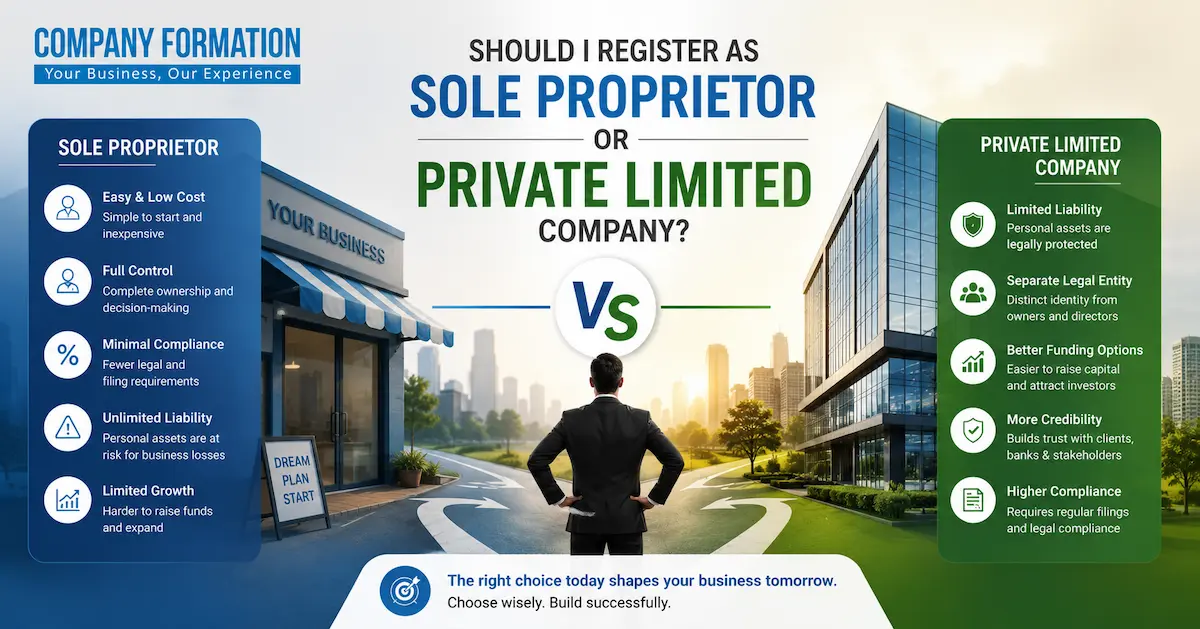
Should I Register as a Sole Proprietor or Private Limited Company?
Starting a business in India involves more than choosing a business idea. One of the first decisions an entrepreneur needs to make is selecting the right legal structure.
For many small business owners, the choice often comes down to Sole Proprietorship vs Private Limited Company. Both structures have their advantages, but they are suitable for different business needs, growth plans, funding requirements, and levels of compliance.
A sole proprietorship may be suitable for an individual running a small business with limited operational requirements. A Private Limited Company, on the other hand, can be a better option for entrepreneurs planning to build a scalable business, raise investment, or establish a separate legal identity.
Let's compare both structures to help you decide which may be right for your business.
What Is a Sole Proprietorship?
A sole proprietorship is a business owned and controlled by one individual. The owner and the business are not separate legal entities.
The proprietor makes the business decisions, receives the profits, and is responsible for the business's liabilities.
A sole proprietorship is commonly used by:
- Freelancers
- Small retailers
- Independent consultants
- Home-based businesses
- Individual service providers
- Small traders
There is generally no separate incorporation process for a sole proprietorship like there is for a company. The business may obtain registrations or licences applicable to its activities, such as GST registration, Shops and Establishments registration, or other local or sector-specific registrations.
What Is a Private Limited Company?
A Private Limited Company is a separate legal entity incorporated under the Companies Act, 2013.
Unlike a sole proprietorship, the company has a legal identity separate from its shareholders and directors.
A Private Limited Company is often preferred by businesses that want to:
- Build a scalable business
- Raise external investment
- Establish a stronger corporate structure
- Protect shareholders through limited liability
- Bring in additional shareholders
- Expand operations
Sole Proprietorship vs Private Limited Company
The following comparison highlights some of the key differences:
| Factor | Sole Proprietorship | Private Limited Company |
|---|---|---|
| Ownership | One individual | Two or more shareholders |
| Separate Legal Entity | No | Yes |
| Liability | Generally unlimited | Generally limited to the extent of shareholding |
| Incorporation | No company incorporation | Formal incorporation required |
| Compliance | Relatively low | Higher |
| Investment | Limited | More suitable for equity investment |
| Ownership Transfer | Difficult | Shares can be transferred subject to applicable restrictions |
| Business Continuity | Closely linked to proprietor | Perpetual succession |
| Credibility | Suitable for small businesses | Generally stronger corporate credibility |
| Scalability | Limited compared with a company | High |
| Management | Owner-managed | Directors manage the company |
When Should You Choose a Sole Proprietorship?
A sole proprietorship may be appropriate if you are starting a small business and want a relatively simple operating structure.
Choose a Sole Proprietorship If:
You are the only owner
If you plan to operate the business independently and do not need shareholders, a sole proprietorship may be suitable.
You are starting on a small scale
For a small local business, freelancer, consultant, or individual service provider, the simplicity of a proprietorship can be attractive.
You want fewer corporate compliance requirements
A proprietorship generally involves fewer corporate formalities than a Private Limited Company.
You do not expect external investors
If your business is expected to remain owner-funded, there may be less need for a corporate equity structure.
You want to test a business idea
Entrepreneurs sometimes start small and later transition to a more structured business entity as their operations grow.
When Should You Choose a Private Limited Company?
A Private Limited Company may be more suitable when you have long-term growth ambitions.
Choose a Private Limited Company If:
You want limited liability protection
A company has a separate legal identity, and shareholder liability is generally limited to their investment in the company, subject to applicable law.
You plan to raise investment
Startups seeking funding from angel investors, venture capital firms, or other investors commonly use a corporate structure.
You want to bring in business partners
A Private Limited Company allows multiple shareholders to hold ownership through shares.
You want to build a scalable business
If you plan to expand into multiple cities, enter new markets, hire a larger team, or develop a larger operation, a company structure can provide a stronger foundation.
You want greater business credibility
A registered Private Limited Company can provide a more formal corporate identity when dealing with customers, suppliers, financial institutions, and investors.
Liability: One of the Biggest Differences
The distinction between personal and business liability is an important factor when choosing between these structures.
In a sole proprietorship, there is no separate legal entity between the proprietor and the business. Therefore, the proprietor can be personally responsible for business liabilities.
A Private Limited Company is a separate legal entity. Shareholders generally enjoy limited liability, although this protection is subject to applicable law and does not protect against every type of personal liability or wrongdoing.
For businesses involving significant financial, contractual, or operational risks, this distinction should be carefully considered.
Which Structure Is Better for Raising Investment?
If you plan to raise external equity investment, a Private Limited Company is generally more suitable.
A company can issue shares to investors subject to the applicable legal and regulatory requirements. This creates a structured ownership model that can accommodate future funding rounds.
A sole proprietorship does not have a comparable shareholding structure because the business and proprietor are legally connected.
Which Is Better for Business Growth?
For long-term scalability, a Private Limited Company generally has an advantage.
A growing company may need to:
- Add shareholders
- Raise capital
- Hire employees
- Enter into larger contracts
- Expand geographically
- Establish subsidiaries
- Work with institutional investors
- Build a structured management team
The corporate structure of a Private Limited Company can accommodate these requirements more effectively.
Which Has Lower Compliance Requirements?
A sole proprietorship generally has fewer corporate compliance requirements because there is no company incorporated under the Companies Act.
A Private Limited Company has ongoing statutory and regulatory obligations, which may include:
- Maintenance of statutory records
- Annual filings with the MCA
- Financial statement filing
- Income tax compliance
- Board and shareholder-related requirements
- Accounting and audit requirements, where applicable
Therefore, entrepreneurs should consider the cost and time associated with ongoing compliance before choosing a company structure.
Sole Proprietorship vs Private Limited Company: Which Is More Cost-Effective?
The answer depends on your business objectives.
A sole proprietorship may be more economical for a small business because it generally has lower setup and ongoing compliance costs.
A Private Limited Company can involve higher incorporation and compliance costs, but it provides benefits such as separate legal identity, limited liability, structured ownership, and greater potential for investment and expansion.
Therefore, choosing solely on the basis of initial cost may not be the best approach.
Consider the long-term value and requirements of your business, rather than just the initial registration expense.
Can a Sole Proprietorship Be Converted Into a Private Limited Company?
Yes, an entrepreneur can move from a proprietorship to a company structure when the business grows or its requirements change.
For example, a business owner may initially operate as a sole proprietor and later establish a Private Limited Company when they need:
- External investment
- Additional shareholders
- Limited liability
- Greater scalability
- A formal corporate structure
The transition should be planned carefully because the tax, contractual, asset, licence, and regulatory implications can vary depending on the business.
Questions to Ask Before Choosing a Business Structure
Before making your decision, consider:
1. How many owners will the business have?
If you are the only owner, a proprietorship may be simpler. If you expect multiple shareholders, a Private Limited Company may be more appropriate.
2. Do you need external investment?
If raising equity investment is part of your business plan, a Private Limited Company is generally better suited.
3. How much business risk is involved?
Businesses with significant contractual, financial, or operational exposure should carefully evaluate the liability implications of each structure.
4. How quickly do you plan to grow?
If you expect rapid expansion, establishing an appropriate corporate structure from the beginning may reduce the need for restructuring later.
5. Are you prepared for ongoing compliance?
A Private Limited Company provides several advantages but also involves greater statutory compliance than a proprietorship.
Which Is Better: Sole Proprietor or Private Limited Company?
There is no universal answer.
A Sole Proprietorship May Be Better If:
- You operate alone
- Your business is small
- You want a simple structure
- You have limited funding requirements
- You do not require external shareholders
- You want fewer corporate formalities
A Private Limited Company May Be Better If:
- You want limited liability protection
- You plan to raise investment
- You want multiple shareholders
- You expect significant business growth
- You want a separate legal identity
- You plan to build a long-term scalable business
Final Thoughts
Choosing between a sole proprietorship and a Private Limited Company depends on your business size, risk exposure, funding requirements, ownership plans, and long-term goals.
If you are testing a small business idea and want a straightforward structure, a sole proprietorship may be suitable.
If you are building a growth-oriented business, planning to raise investment, work with multiple shareholders, or establish a separate corporate identity, Private Limited Company registration may be a more appropriate option.
Before making a decision, evaluate both the immediate and future requirements of your business. Professional company formation advice can help you understand the applicable legal, tax, and compliance implications and select a structure that fits your business objectives.
Frequently Asked Questions
1. Is a sole proprietorship better than a Private Limited Company?
It depends on the business. A proprietorship may be suitable for small, owner-operated businesses, while a Private Limited Company can be more appropriate for businesses seeking limited liability, investment, multiple shareholders, and long-term growth.
2. Is Private Limited Company registration mandatory for every business?
No. Businesses in India can operate through different legal structures depending on their activities and requirements. A Private Limited Company is one option among several available structures.
3. Which is easier to start, a sole proprietorship or Private Limited Company?
A sole proprietorship is generally simpler because it does not require incorporation as a separate company. Private Limited Company registration involves a formal incorporation process and ongoing corporate compliance.
4. Can a sole proprietor have limited liability?
A sole proprietorship does not provide the same separate legal entity and statutory limited-liability framework as a Private Limited Company.
5. Can a Private Limited Company have only one owner?
A standard Private Limited Company requires at least two members. An entrepreneur who wants a company structure with a single member may consider whether an OPC or another suitable structure meets their requirements.
6. Which structure is better for startups?
A Private Limited Company is commonly preferred by startups that expect to raise equity investment, add shareholders, scale operations, or build a formal corporate structure. However, the appropriate structure depends on the startup's specific circumstances.
7. Can I change from a sole proprietorship to a Private Limited Company later?
Yes. A business can transition to a company structure as its needs evolve, subject to applicable legal, tax, contractual, and regulatory requirements.