Blog

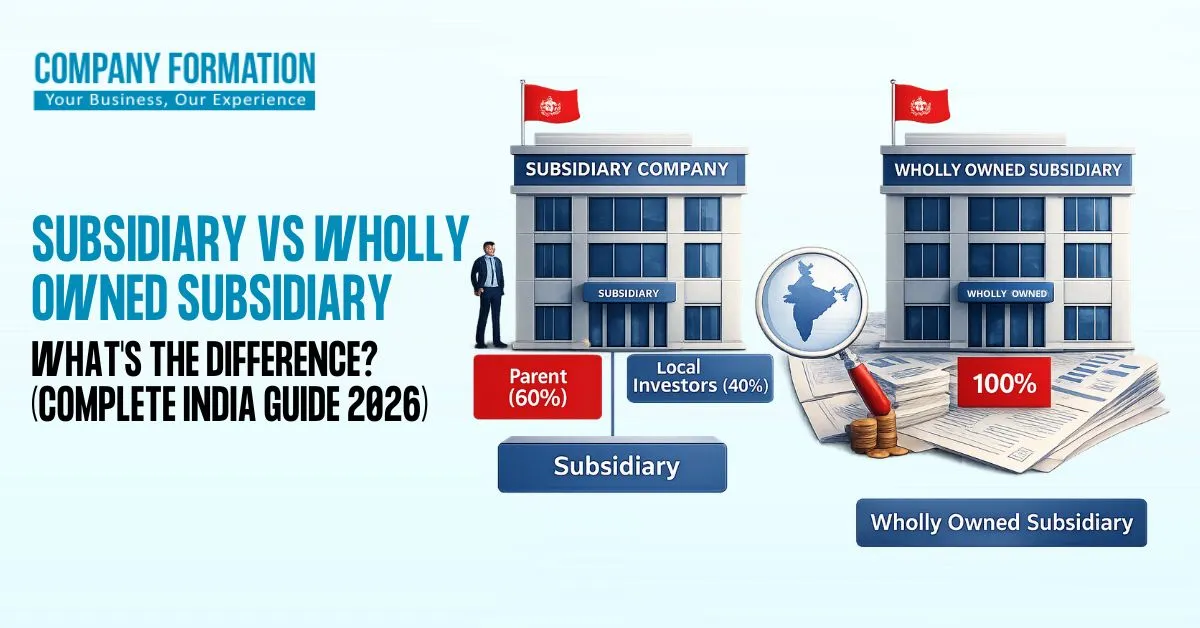
Subsidiary vs Wholly Owned Subsidiary – What's the Difference? (Complete India Guide 2026)
When expanding a business into India, companies often come across two commonly used terms — Subsidiary Company and Wholly Owned Subsidiary (WOS). While these terms are related, they are not exactly the same.
Understanding the difference is important for foreign companies, investors, and entrepreneurs planning company formation in India.
In this guide, we explain the meaning, structure, ownership, legal differences, and which option may be suitable for your business.
What is a Subsidiary Company?
A subsidiary company is a company that is controlled by another company, known as the holding company or parent company.
Under the Companies Act, 2013, a company is considered a subsidiary when the parent company:
- Controls the composition of the Board of Directors, or
- Holds more than 50% of the total voting power / share capital
This means the parent company has significant control, but it may not necessarily own 100% of the company.
Example
If a foreign company owns 60% shares in an Indian company and local investors own the remaining 40%, the Indian entity is a subsidiary company.
What is a Wholly Owned Subsidiary?
A Wholly Owned Subsidiary (WOS) is a specific type of subsidiary where the entire share capital (100%) is held by the parent company.
In simple terms:
Every wholly owned subsidiary is a subsidiary, but not every subsidiary is wholly owned.
This structure is commonly used by multinational corporations entering India.
Example
If a US-based company owns 100% shares of an Indian Private Limited Company, it is called a Wholly Owned Subsidiary in India.
Key Difference Between Subsidiary and Wholly Owned Subsidiary
| Basis | Subsidiary Company | Wholly Owned Subsidiary |
|---|---|---|
| Ownership | More than 50% | 100% |
| Minority Shareholders | May exist | No external shareholders |
| Control | Majority control | Complete control |
| Decision-making | Shared in some cases | Full control by parent |
| Profit Sharing | Shared with minority owners | Fully belongs to parent company |
Ownership Structure Explained
Subsidiary
The parent company may hold:
- 51%
- 60%
- 75%
- 90%
The remaining shares can be held by:
- Local investors
- Co-founders
- Strategic partners
- Joint venture partners
Wholly Owned Subsidiary
The parent company owns 100% shares, directly or through nominee shareholders as required for legal compliance.
In India, for a Private Limited Company, minimum 2 shareholders are required, so nominee holding structures may be used while beneficial ownership remains with the foreign parent.
Which One is Better for Foreign Companies?
It depends on your business objective.
Choose a Subsidiary When:
- You want local investors
- You need a strategic Indian partner
- You want joint venture participation
- Sector rules require local ownership
Choose a Wholly Owned Subsidiary When:
- You want full control
- You want full profit repatriation
- You want centralized decision-making
- You need complete brand ownership
Most multinational companies prefer a Wholly Owned Subsidiary in India for long-term market entry.
Legal and Compliance Perspective in India
Both structures are generally incorporated as Private Limited Companies under the Companies Act, 2013.
Common compliance requirements include:
- ROC filings
- Annual returns
- Audit compliance
- Income tax filing
- GST registration (if applicable)
- FEMA / FDI compliance for foreign investment
If foreign investment is involved, FDI regulations under FEMA must also be checked.
Taxation Difference
From a taxation standpoint, both are taxed as Indian companies.
However, profit distribution differs:
Subsidiary
Profits may be distributed according to shareholding ratio.
Wholly Owned Subsidiary
All profits after tax belong to the parent company.
This makes WOS more attractive for foreign corporations.
Common Use Cases in India
Subsidiary
- Joint ventures
- Strategic partnerships
- Local collaboration models
Wholly Owned Subsidiary
- Global technology companies
- Foreign consulting firms
- International manufacturing companies
- Global payroll / EOR companies
Conclusion
The main difference lies in ownership percentage and control.
- Subsidiary = majority ownership (more than 50%)
- Wholly Owned Subsidiary = 100% ownership
If your business expansion plan requires full control, stronger brand governance, and complete ownership, a Wholly Owned Subsidiary is usually the preferred route.
For businesses planning collaboration with local investors or strategic partners, a subsidiary structure may be more suitable.