Blog

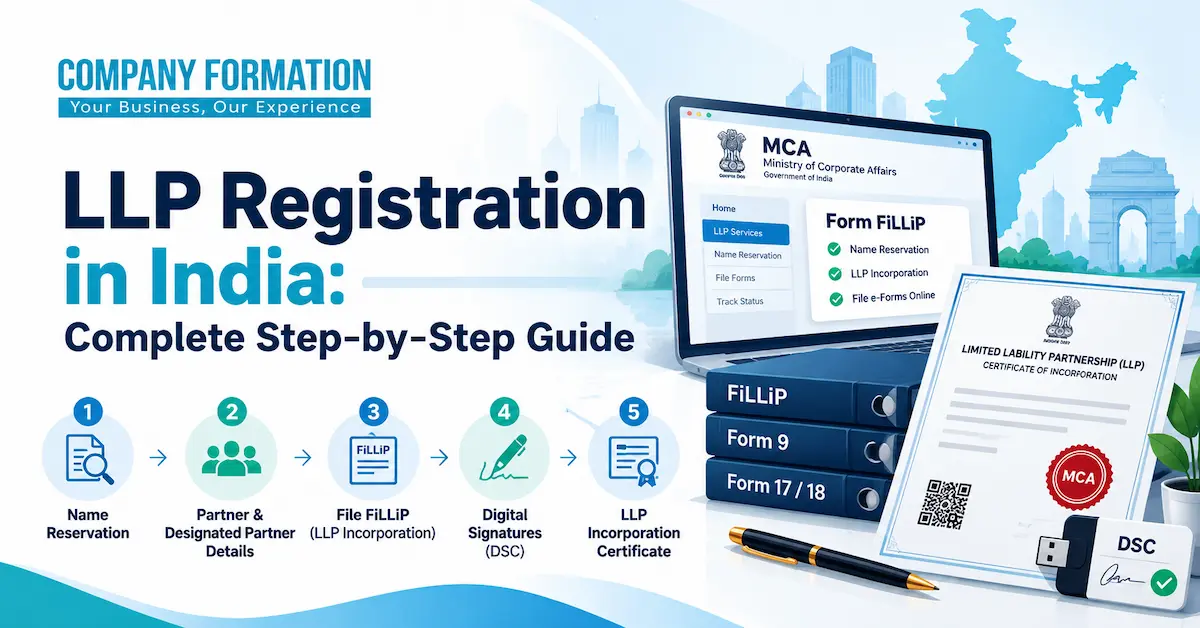
LLP Registration in India: Complete Step-by-Step Guide
Starting a business in India is exciting—but choosing the proper legal structure can substantially impact your organization's compliance, liability, taxation, and development.
For some, a Limited Liability Partnership (LLP) may be an appealing business structure if you desire a flexible partnership arrangement, but also want some limited liability protection.
However, how to register an LLP in India? What papers do you need? What is the cost of registration of LLP? How long does it take to complete? What compliance does one need to adhere to, after incorporation?
This comprehensive guide to LLP registration in India addresses all these questions and takes you through the registration process, point by point.
This guide will help you to comprehend the LLP registration process in India step-by-step, whether you are a startup founder or a professional, consultant, a family business owner, or an entrepreneur planning to start a new venture.
What Is an LLP?
A Limited Liability Partnership (LLP) is a business structure that is formed with features of partnership business structure along with limited liability features.
An LLP is governed primarily by the Limited Liability Partnership Act, 2008 and the rules made under it. The LLP is a legal entity separate from its partners and the liability of the partners is generally limited, unless restricted by the applicable law and their contribution.
An LLP is not a partnership like a partnership, and can offer more protection for the personal assets of the partners than a normal partnership.
Key Features of an LLP
Some important features of an LLP include:
- Separate legal entity
- Limited liability of partners, subject to applicable law
- Perpetual succession
- Minimum two partners
- Minimum two designated partners
- A minimum of one designating partner should fulfil the 'resident in India' requirement.
- The internal management of the company is flexible, and this is achieved by an LLP Agreement.
- Flexibility in compliance requirements, in comparison to many company structures
- No minimum capital contribution prescribed like company share capital
The MCA's current FiLLiP instructions specify that an LLP must have at least two designated partners, with at least one resident in India.
Who Should Consider LLP Registration?
LLP registration can be particularly relevant for companies that are looking for flexibility and protection from liability at the same time.
An LLP may be considered by:
- Consultants
- Those who are registered as chartered accountants or other professionals who are subject to the relevant professional rules.
- Lawyers and professional firms, subject to applicable regulations
- IT and software businesses
- Marketing agencies
- Freelancers joining together as a business
- Startups with multiple founders
- Small and medium-sized businesses
- Family-owned businesses
- Service-based businesses
- Companies in which partners desire flexible profit sharing agreements.
Different business structures have different benefits, and will depend on the business owner's goals, funding options, tax considerations, and regulations.
LLP Registration in India: Eligibility Requirements
Prior to the commencement of the LLP registration process, the basic requirements for the proposed LLP should be ensured.
1. Minimum Two Partners
There must be at least two partners in an LLP.
Generally partners can be either a person or a body corporate, as per the conditions outlined in the LLP Act and rules.
2. Minimum Two Designated Partners
There must be at least two designated partners to run the LLP.
Statutory duties of designated partners include compliance and filing.
3. Resident Designated Partner
One of the two partners (one or both) should be a resident of India as required.
The condition of the resident at MCA is mentioned in the incorporation instructions and it is defined currently as for at least 182 days in the preceding year.
4. Digital Signature Certificate
Electronic filing with the MCA is a part of the incorporation process of an LLP; hence, suitable arrangements must be made for the signatories to sign the documents electronically.
According to V3 of MCA, users who are mandated to sign with their DSC should link their DSC to their MCA profile.
5. Registered Office
The LLP should have a registered office in India where registered official communications should be addressed.
Documents Required for LLP Registration
There are various documents required to incorporate a company, and having them ready can speed up the process.
Documents Required From Partners
This can vary by partners, but typical documents will include:
- PAN card for Indian partners
- Proof of identity
- Address proof
- Passport-size photograph
- Residential address proof
- Email ID
- Mobile number
- Digital Signature Certificate
- Passport and relevant documents for foreign nationals/NRIs, where applicable
The documentation will depend on the partner's status and the incorporation structure.
Registered Office Documents
The paperwork for the registered office can contain:
- Proof of registered office address
- Utility bill, where applicable
- Rent/lease agreement, if applicable
- No-objection certificate from the owner, where required
- Ownership-related documents, where applicable
Important: Document should be consistent, valid, legible and in the required format to minimise re-submission.
LLP Registration Process in India: Step-by-Step
The LLP incorporation process is carried out through the Ministry of Corporate Affairs (MCA) portal.
The current webform of MCA FiLLiP includes several incorporation related services such as Name Reservation, DPIN/DIN Allotment (in applicable cases), LLP incorporation and PAN/TAN allocation.
Easier to understand steps for the process.
Step 1: Obtain Digital Signature Certificates
The first step is to organise DSCs for the proposed designated partners/signatories.
This is a Digital Signing Certificate (DSC) used for digitally signing an electronic form that is submitted to the MCA.
In MCA V3, users who wish to digitally sign forms should adhere to MCA's DSC association process.
Step 2: Select a Suitable LLP Name
The selection of the Correct LLP Name is an important aspect of incorporation.
Your proposed name will have to meet the naming criteria and should not cause confusion with a similar or existing company or LLP.
Before finalizing the name, check:
- Existing LLP names
- Company names
- Trademark conflicts
- Similar or closely resembling names
- Words requiring regulatory approval
- If the name chosen is appropriate for the business
The MCA keeps a database of company and LLP names from which a search facility is provided by the MCA.
Step 3: Reserve the LLP Name
The proposed name may be reserved via the MCA process.
Name reservation may be done with the relevant MCA service (integrated FiLLiP process).
According to MCA, an application for the reservation of name and incorporation of LLP will be available via the FiLLiP.
If you've reserved a name previously, be sure to remember the approved name and its expiration date before incorporating.
Step 4: Prepare the LLP Incorporation Application
After the requirements for the name have been met, draft an incorporation application.
The current MCA FiLLiP form can be used for:
- LLP name reservation
- DPIN/DIN allotment where applicable
- LLP incorporation
- Consent of designated partners
- Certain conversion applications
- PAN/TAN allocation
According to MCA, FiLLiP is a webform for name reservation or LLP incorporation with Registrar.
Step 5: Provide Partner and Designated Partner Details
The incorporation application must provide information about the proposed partners and the designated partners.
You may need to provide information such as:
- Full name
- Father's/mother's name, where applicable
- Date of birth
- Nationality
- PAN/passport details
- Residential address
- Designation
- DPIN/DIN, where applicable
- Contribution
- Consent-related information
Ensure that all information is consistent with the supporting documents.
Step 6: Submit the Required Documents
Include necessary supporting documents with incorporation application.
Depending on the circumstances, these may include:
- Identity proof
- Address proof
- PAN/passport
- Registered office proof
- NOC
- Subscriber/partner-related documents
- Consent forms
- Other supporting documents required by MCA
A resubmission request could be issued if there are any inaccuracies or inconsistencies in the documents.
Step 7: File the Form With the MCA
Once application is completed, send it digitally signed via the MCA application portal.
Any fees as per government fee structure are to be paid.
MCA publishes the fee schedule with different incorporation fee slabs according to proposed LLP's contribution.
Step 8: MCA/ROC Processing
The Registrar reviews the application and supporting documents when they are submitted.
Once the application is accepted as being compliant with the requirements of the LLP, the company is formed.
If clarification and/or improvement is needed, the application can be resubmitted.
Hence, it is essential to keep an eye on the status of the applications after filing.
Step 9: Receive the Certificate of Incorporation
When approved the LLP will be issued with a Certificate of Incorporation.
This certificate provides confirmation of the incorporation of LLP.
The LLP will also get their LLPIN (Limited Liability Partnership Identification Number).
The MCA's incorporation guidance provides for issuance of the certificate of incorporation upon its satisfaction of relevant statutory requirements.
Step 10: Execute the LLP Agreement
The LLP Agreement is one of the most crucial post incorporation tasks.
The LLP Agreement usually makes the following provisions:
- Rights and responsibilities of partners
- Capital contribution
- Profit-sharing ratio
- Building a legally sound an LLP name, filing an LLP incorporation application, submitting the documents related to the partners and registered Office of the LLP, paying the relevant government fees, obtaining Certificate of Incorporation and LLPIN and completing the LLP Agreement and post-incorporation compliances are all important steps to make.
- Admission of new partners
- Retirement/resignation
- Duties of designated partners
- Dispute resolution
- Management structure
- Distribution of profits
- Other mutually agreed provisions
A properly drafted LLP Agreement can help save from the misunderstandings that may arise between partners in the future.
The agreement must be duly executed and filed in the proper MCA form on time.
How Long Does LLP Registration Take?
The timeline will be determined by:
- Name availability
- Accuracy of documents
- MCA processing
- Resubmission requirements
- DSC readiness
- Partner documentation
- Registered office documentation
Incorporation can be relatively expedient if the application is complete and there are no objections or requirements for resubmission.
The older guidance on incorporation by MCA says that once a proper incorporation is completed and requirements are met, the Registrar will register LLP within the required time.
But no number of days should be assumed as a fixed processing time by businesses due to the fact that it can differ from one instance to another.
LLP Agreement: Why It Matters
There are many people who are only interested in getting the Certificate of Incorporation and forget about LLP Agreement.
That can be a mistake.
The agreement sets out the way the partners will operate.
If two partners form an LLP, for instance:
- Partner A contributes ₹6 lakh
- Partner B contributes ₹4 lakh
They may choose to divide the profits 60-40 (or other formula allowed by the agreement and applicable law).
These commercial terms should be explicitly agreed in the agreement, and not left to chance.
Important Clauses in an LLP Agreement
Some of the following might be included:
- Name and registered office
- Business activities
- Partner contributions
- Profit and loss sharing
- Partner responsibilities
- Designated partner responsibilities
- Banking arrangements
- Drawings/remuneration, where applicable
- Admission of new partners
- Retirement or resignation
- Transfer of partnership rights
- Death/incapacity of a partner
- Dispute resolution
- Confidentiality
- Intellectual property
- Non-solicitation provisions, where legally appropriate
- Dissolution and winding-up
- Amendment procedure
The professional contract should be drafted in line with the specific business – don't copy from any other template.
LLP vs Private Limited Company
Entrepreneurs often compare an LLP with a private limited company.
| Feature | LLP | Private Limited Company |
|---|---|---|
| Separate legal identity | Yes | Yes |
| Limited liability | Generally yes, subject to law | Yes, subject to law |
| Minimum members | 2 partners | 2 members |
| Management | Partners/designated partners | Directors |
| Ownership mechanism | Partnership interest/contribution | Shares |
| Compliance structure | Generally more flexible | Generally more extensive |
| External equity funding | Less straightforward | Generally more suitable |
| Suitable for professional/service businesses | Often suitable | Often suitable |
| Perpetual succession | Yes | Yes |
Neither structure is universally appropriate. The right choice depends on the nature of the business, funding requirements, ownership model, regulatory environment, and future plans.
Advantages of LLP Registration
1. Limited Liability
The limited liability framework is one of the major advantages offered by an LLP.
A partner of an LLP is not personally liable for the obligations of the LLP just because he or she is a partner unless specifically provided for by the law and due to acts of a partner or due to his or her wrongful conduct.
2. Separate Legal Entity
The LLP is legally distinct from the partners.
This enables the LLP to hold property and sign contracts and do business using the company name.
3. Flexible Management
LLPs provide a great degree of flexibility in terms of the relationship between the partners.
4. No Traditional Share Capital Structure
The operation of an LLP is not as share based as in the case of a company.
5. Suitable for Professional Businesses
This structure may be applicable to other companies and services dependent on the type of company.
6. Perpetual Succession
Changes in partners do not necessarily bring the LLP's existence to an end.
Disadvantages of an LLP
Entrepreneurs need to also be aware of the constraints of an LLP prior to registering it.
Limited Access to Equity Investment
An LLP does not issue shares like a private limited company does.
This can complicate some types of equity financing.
Compliance Is Still Mandatory
An LLP is not a ‘zero compliance' business structure.
Has statutory filing and record-keeping obligations.
Partner Structure Can Become Complex
The more partners there are, the more substantial your agreements and processes need to be.
Certain Investors May Prefer Companies
The type of investment strategy and legal requirements may dictate the type of corporate structure that is preferred by institutional investors and by VCs.
LLP Annual Compliance Requirements
The registration of an LLP is just the initial step.
Once incorporated, you will be required to keep complying with applicable compliance requirements.
Common LLP compliance obligations include:
- Filing annual return
- Filing Statement of Account & Solvency
- Properly keeping financial books and documentation
- Filing income tax returns
- Maintaining statutory records
- Keeping MCA records up to date if partner/designated partner changes
- Submitting appropriate event-related forms
- Maintaining the registered office
- Complying with relevant tax and regulatory obligations
The exact compliance requirements may vary depending on the turnover, contribution, business activities and other factors of the LLP.
LLP Annual Return
All LLP's must submit their Annual Return to MCA in the prescribed form.
The annual return is a document that contains details of the LLP and its partners/designated partners.
Will incur extra cost and other penalties if filing requirements are not met.
Statement of Account and Solvency
An LLP must also make and file the appropriate Statement of Account and the Statement of Solvency.
This sets out financial information about the LLP as part of the statutory compliance regime.
It is best for businesses to keep good books and supporting records during the year instead of trying to piece things together at the time of filing.
Taxation of LLP in India
One of the factors that needs to be taken into account while choosing the business structure is LLP taxation.
Usually, an LLP is considered to be a partnership for income tax purposes, as stipulated in various provisions of the Income-tax Act and related rules.
Depending on the LLP's circumstances, tax considerations may include:
- Income tax
- Tax treatment of partner remuneration/interest, subject to applicable provisions
- TDS
- GST, where applicable
- Advance tax
- Other applicable indirect taxes and regulatory obligations
However, since tax regulations may change, businesses should consult their tax advisors in light of their unique situation.
Common Mistakes to Avoid During LLP Registration
Be prepared for a smooth LLP registration process!
Avoid these common mistakes:
1. Choosing a Name Without Checking Availability
It is possible for a name to seem unique when in fact it is not unique and is actually comparable with an existing company, LLP or trademark.
2. Incorrect Partner Information
Problems can arise due to minor differences in PAN, identity documents and incorporation application.
3. Using Invalid Address Proof
Ensure that the necessary address document(s) are in accordance with relevant requirements.
4. Ignoring the LLP Agreement
Do not take the agreement lightly.
It sets out the business dealings between business partners.
5. Underestimating Post-Incorporation Compliance
The filing of the LLPIN is not an end to the compliance obligations.
6. Selecting the Wrong Contribution Structure
A contribution to be commensurate with the business agreement between the partners and documented accordingly.
7. Failing to Update MCA Records
Statutory filings may be required if there are any changes in designated partner(s), registered office or other information.
Why Professional Assistance Makes LLP Registration Easier
While LLP registration process in India is online, any mistake in documentation, name selection, MCA form or LLP Agreement can cause unnecessary delays.
Professional assistance can help with:
- Document verification to minimize errors and resubmissions.
- LLP name selection and checking potential conflicts.
- MCA filing and incorporation formalities.
- LLP Agreement drafting based on the partners' requirements.
- Post-registration compliance and annual filings.
- Guidance on fees, stamp duty, and applicable requirements.
By having that expert assistance, you will save time, avoid some common pitfalls and concentrate on business growth.
Conclusion: Start Your LLP the Right Way
The registration of an LLP in India enables entrepreneur to create the kind of structure that allows them to operate a substantive business in an efficient manner while also enjoying the advantages of a separate legal entity and a limited liability mode of operation.
But incorporation is only the first step.
Selecting a name, filing the proper documentation, making contributions of the partners and having the appropriate LLP Agreement is something that should be considered carefully.
If you're planning to start an LLP, don't leave the registration process to guesswork.
Ready to Register Your LLP?
Contact our LLP registration experts for professional assistance
FAQs | LLP Registration in India
1. Can one person register an LLP?
No. LPPs must have a minimum of two partners. It shall also have two or more partners designated as partners; at least one of which shall meet the condition of being a resident of India.
2. Is LLP registration compulsory?
If you want to operate specifically as an LLP, incorporation with the MCA is required to establish the LLP as a registered legal entity.
3. Can foreigners become LLP partners?
Foreign participation may be allowed in accordance with the Indian laws, foreign investment regulations, sector specific requirements and documentation.
4. Does an LLP need a registered office?
Yes. LLP has to establish its registered office in India for all its communications.
5. Is GST registration mandatory for an LLP?
Not just because of the business being an LLP. The eligibility criteria for GST registration are based on the type of supplies and the turnover and any other relevant GST criteria.
6. Does LLP require an audit?
The size and nature of the audit will depend on the situation of the LLP and the thresholds/rules. The financial situation of the LLP should be taken into account before taking professional advice.
7. Can an LLP be converted into a private limited company?
Wherever provided by the laws and regulations, some conversion/restructuring routes may be feasible depending on the conditions specified in the laws and regulations.
8. Can an LLP raise funding?
Unlike a company, there are permitted ways for an LLP to raise funds. It will be important for businesses to think carefully about implications if they're seeking institutional equity investment.