Blog

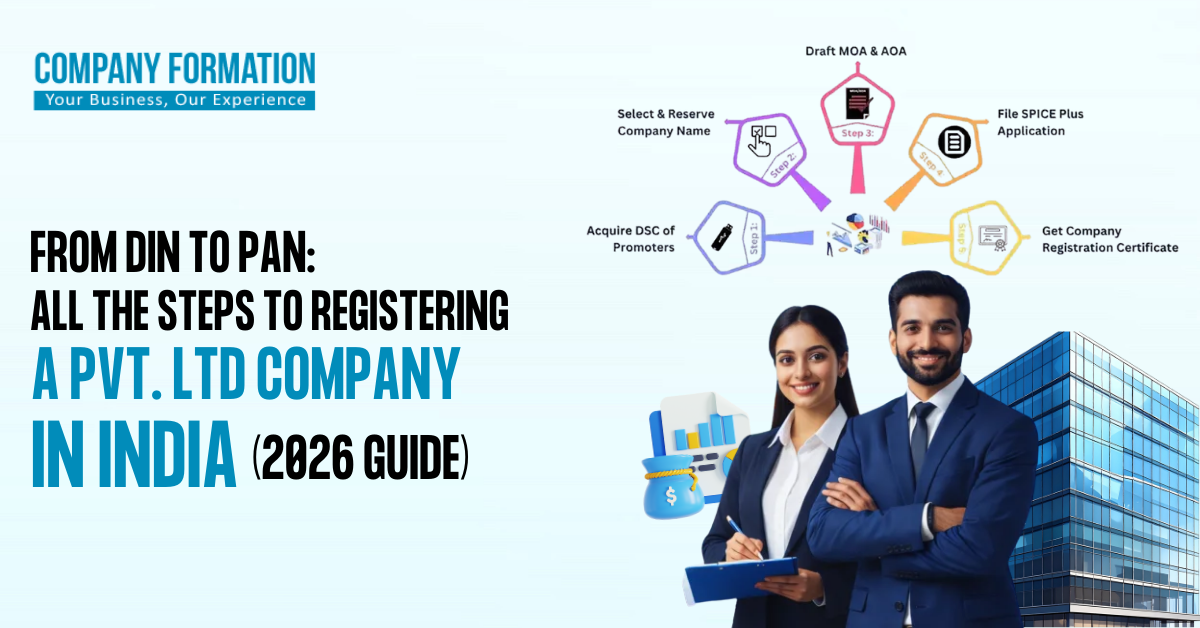
From DIN to PAN: All the Steps to Registering a Pvt. Ltd Company in India (2026 Guide)
Starting a Private Limited Company (Pvt. Ltd.) is one of the most popular and legally secure ways to launch a business in India. Whether you are a startup founder, SME owner, or foreign investor, understanding the step-by-step registration process is essential to avoid delays and compliance issues. If you're planning company formation in India, this guide explains everything — from obtaining a DIN (Director Identification Number) to receiving your PAN (Permanent Account Number). forming a subsidiary company is often the most strategic entry route.
Why Choose a Private Limited Company?
A Private Limited Company offers:
- Private Limited Company?
- Separate legal identity
- Easy transfer of shares
- Better credibility with investors and banks
- Eligibility for funding and startup benefits
This structure is ideal for entrepreneurs planning scalable business operations in India.
Step-by-Step Process to Register a Pvt. Ltd Company in India
Step 1️⃣ Obtain Digital Signature Certificate (DSC)
The first requirement is a Digital Signature Certificate (DSC) for all
proposed directors.
Since company registration is completely online through the Ministry of Corporate Affairs
(MCA) portal, DSC is required to digitally sign incorporation documents.
Documents required:
- Passport-size photo
- PAN card copy
- Address proof
Without DSC, you cannot proceed with incorporation filings.
Step 2️⃣ Apply for Director Identification Number (DIN)
The Director Identification Number (DIN) is a unique number issued to individuals who wish to become directors of a company.
DIN is applied through the SPICe+ form at the time of incorporation.
Requirements:
- Minimum 2 directors (for Private Limited Company)
- At least one director must be an Indian resident (182+ days in India during the financial year)
Once approved, the DIN remains valid for lifetime.
Step 3️⃣ Name Approval Through SPICe+ (Part A)
The next step is reserving your company name via the RUN (Reserve Unique Name) or SPICe+ Part A process.
Your proposed name must:
- Be unique and not similar to existing companies
- Follow MCA naming guidelines
- Reflect the business activity
If approved, the name is reserved for 20 days.
Tip: Always keep 2–3 backup name options to avoid rejection.
Step 4️⃣ Drafting MOA & AOA
The Memorandum of Association (MOA) and Articles of Association (AOA)define:
- Business objectives
- Share capital structure
- Internal management rules
These documents are submitted electronically through SPICe+ during incorporation.
Step 5️⃣ Filing SPICe+ Form (Part B)
SPICe+ Part B includes:
- Incorporation details
- Director details
- Registered office address
- Capital structure
- Subscriber details
- DIN
- PAN
- TAN
- GST (optional)
- EPFO & ESIC registration
This integrated form also allows application for:
This makes the process streamlined and faster.
Step 6️⃣ Certificate of Incorporation (COI)
Once approved by the Registrar of Companies (ROC), you receive:
- Certificate of Incorporation (COI)
- Corporate Identification Number (CIN)
- PAN & TAN allotment
At this stage, your Private Limited Company becomes a legally registered entity.
Step 7️⃣ PAN & TAN Issuance
PAN (Permanent Account Number) and TAN (Tax Deduction Account Number) are automatically generated through SPICe+.
These are required for:
- Opening a company bank account
- Filing income tax returns
- Deducting TDSPAN & TAN allotment
PAN is mandatory for all financial transactions of the company.
Step 8️⃣ Opening a Bank Account
After receiving COI and PAN:
- Open a current account in the company’s name
- Deposit subscribed share capital
- Maintain proper financial records
Bank KYC typically requires:
- COI
- PAN
- MOA & AOA
- Board resolution
Documents Required for Pvt Ltd Company Registration
- PAN & Aadhaar of directors
- Passport (for foreign nationals)
- Address proof
- Utility bill for registered office
- NOC from property owner/li>
- Passport-size photos
Timeline & Cost
Timeline: 7–15 working days (subject to document readiness)
Cost: Depends on authorized capital and professional fees
If you are planning company registration in Delhi, Gurgaon, or anywhere in India,working with experienced professionals can significantly reduce approval delays.
Post-Incorporation Compliance
After registration, you must ensure:
- Appointment of auditor within 30 days
- Filing of commencement of business (if applicable)
- Annual ROC filings
- Income tax compliance
- GST compliance (if registered)
Non-compliance may lead to penalties or director disqualification.
Conclusion
Registering a Private Limited Company in India is a structured yet straightforward process when done correctly. From obtaining a DIN and DSC to receiving your PAN and Certificate of Incorporation, every step must be executed carefully.
If you are planning to start your business journey in India, professional support for company formation services in India ensures compliance, speed, and peace of mind.